We’ll start by admitting that starting anything new is hard. There’s a reason it’s so common for people to give up on their New Year’s resolutions by February—because building a new habit is an uphill battle from the start.
Exercising more is the most common New Year’s resolution, and it’s also the first one to go out the window.
If you’re reading this—whether it’s January or June—you probably don’t want that to be your story. And our goal is to set you up for success from the start.
This guide has plenty of tools, advice, and resources to help you begin a lifelong habit of exercising. New to fitness or new to actually understanding it, this is the knowledge you need to move forward.
How to Set Goals
Setting goals might sound like a simple thing, but it’s challenging to set realistic and motivating goals that keep you going. People tend to run into these common roadblocks when setting goals:
- You set goals that are completely out of reach. You’re not going to be able to go from zero to 10 pull-ups in your first month of exercising. That’s a fact. But many people set goals that are similarly unrealistic.
- You set goals you don’t really care about. All too often, we set goals for ourselves that are really being driven by someone else, whether that’s a family member, a coworker, or even the media. If your goal isn’t personally meaningful to you, you’ll have a hard time drumming up enough motivation to work on that goal.
- You set goals that are too vague to really be actionable. “Exercise more” is a really good example. What does that mean, exactly? How will you know if you’re making progress?
There are thousands of books about goal setting because this is universally challenging. With a good framework, though, you can learn to set goals that are both achievable and motivating. Let’s look at a few strategies to help you set meaningful goals.
Start With Why
There’s a great book by Simon Sinek called, Start with Why (you can also watch his TED Talk on the same topic if you’re short on time). It’s more geared toward entrepreneurs and business leaders, but his main idea is just as essential to setting goals with a new fitness program.
It’s all about taking a step back and defining why you’re doing this—beyond the vague “get in shape.”
What’s your real purpose in starting an exercise program?
For many people, it’s about getting overall healthier so they can be comfortable with their bodies or, thinking of longevity, being able to tackle a flight of stairs without thinking about it.
For others, it’s about reconnecting with an old athletic hobby that used to bring them a lot of joy. And for others still, it might be about getting past chronic pain they’ve lived with for years.
Choosing to start an exercise journey is hard, and you should be proud of yourself for even making that choice. When we make hard choices like that, there’s always a deeper reason for doing so, even if we don’t realize it right away.
If your goal is to lose 20 pounds, think through your personal “why” behind that goal. There’s no right or wrong answer, as we each have different things that are important to us. If your motivation is tangible and meaningful to you, that’s something you can keep coming back to, especially on those days when the last thing you want to do is exercise.
Many people skip this step when setting goals, but you’ll be glad you took the time to think through the deeper purpose driving you to put in this work.
Find What Motivates You
Knowing your “why” is a big part of staying motivated and setting goals accordingly. Another important piece is tapping in to what psychologists and social scientists refer to as intrinsic motivation and extrinsic motivation.
- Intrinsic motivation comes from the thing itself—in this case, exercise. People who like exercising or feel really good when they work out can draw on that intrinsic motivation.
- Extrinsic motivation comes from something external. That could be a reward of some kind—“If I do 20 workouts, I’ll buy a new pair of shoes”.
Research shows that these different kinds of motivation are pretty much equally effective. Just having a clear motivation is what makes the difference in success with achieving goals.
One theme that will come up throughout this guide is that the key to success is knowing what works for you. If a certain tool or approach works really well for your friend or colleague, that doesn’t mean it will work well for you.
So, if intrinsic motivation is an effective tool for you, then great. Let’s say you just feel better when you exercise—that doesn’t mean you’ll automatically have the motivation to exercise. You’ll need to remind yourself about how exercising makes you feel (and how not exercising makes you feel), and draw motivation from that.
Maybe you’re more motivated by extrinsic things, like rewards. You might print out a picture of the reward you want and hang it on your fridge or in front of the treadmill—whatever works.
Set SMART goals
This mnemonic device for goal setting is popular for a reason—because it works. SMART stands for:
- Specific. Make sure your goal is specific rather than being broad and vague. For example, instead of a goal of “get stronger,” a better goal might be to “build up the strength to do push-ups.”
- Measurable. Your goal should also be quantifiable so that you can track your progress. So, that might be: “build up the strength to do 10 consecutive push-ups.”
- Achievable. How realistic is this goal? If you’ve never done a push-up in your life, 10 push-ups might not be so achievable right now. Maybe that goal needs to be dropped down to five, or three, or even one.
- Relevant. This brings us back to your “why.” Is the goal you’re setting relevant to what’s most important to you? Let’s say your “why” is being able to stand up on a surfboard. Being able to do a push-up might be a great goal then, since that strength translates into being able to push yourself off the board and onto your feet.
- Timebound. Finally, setting time limits to any goal is a good idea so you can check in periodically. Though, It’s important to realize that progress is not linear, and time limits are usually pretty arbitrary. So, if you set a goal of “build up the strength to do one good push-up within two months,” just remember that you can adjust that time along the way.
This formula is not set in stone, but is a good framework for defining your goals, especially after you’ve gone through the work of figuring out the deeper purpose behind them.
Write it Down
This might be the most important step of all. You might dismiss this as unnecessary, but we recommend doing it anyway.
You might write this down in a journal, in a note on your phone, or on a scrap piece of paper you stick to your bathroom mirror. Whatever you do, jot down the answers to the following:
- What is my “why,” my deeper purpose for starting this exercise program?
- What works better for me, intrinsic motivation or extrinsic motivation? What, specifically, can I draw motivation from?
- How is my goal SMART?
Once you’ve answered these questions, you should wind up with a very clear and meaningful goal, like the one we identified in the previous section:
“I want to build up the strength to do one push-up within the next two months so that I can easily get up off the board when I learn to surf in California.”
Come back to this goal periodically to remind yourself about why you’re doing this and what you’re working toward. That way, you can assess whether you’re making progress toward that goal or if you need to adjust what you’re doing.
Creating Accountability
We’re all human. Sometimes, even motivational strategies, like reminding ourselves of our deeper purpose for exercising, just won’t cut it. When you can’t get yourself going, having someone else holding you to your commitment can be the kick you need to follow through. That’s why establishing a specific plan for accountability is big.
Accountability can come in different forms, and you may need to try a couple of strategies before you find what works for you. Here are some possibilities:
Find an Accountability Buddy
For many people, it can be really helpful to have a friend, coworker, or family member going through this process at the same time. That might mean someone who goes to the gym with you or a friend you exchange texts with on your planned workout days.
This helps in both directions. You know someone else is paying attention to whether or not you’re showing up, but you also have the motivation to help another person stay committed. It’s a win-win.
Try Group Training
Group training doesn’t work for everyone, but it’s an effective accountability and training tool for a growing number of exercisers. There are plenty of options for group training, including classes in your gym, a fitness studio, a local community center, or at the local park.
There are also new online group training options cropping up every day. You can find exercise classes covering a wide range of goals and approaches held over video platforms like Zoom or dedicated streaming services.
Training in a group is like having multiple accountability buddies. If you stop showing up, the teacher or other people in the class will likely notice your absence and can check in with you.
Additionally, if you find yourself paying for a gym membership to access classes, you’ll be more motivated to go and get your money’s worth.
Use an App
There are hundreds, if not thousands, of apps on the market now to create accountability and help you build new habits, many of which are specifically for tracking exercise. You can set up reminders and notifications through any of these apps. Here are just a few that might help:
- Fitness tracker apps, like MyFitnessPal or Strava
- Productivity or habit-building apps, like Done
- Apps for specific training modalities, such as the Peloton app or the Nike Run Club app
Don’t underestimate the power of accountability. When we know someone else (even if that’s an app) is counting on us, we’re much more likely to keep showing up.
How to Choose a Program
You’ve set a clear goal, you know your deeper purpose for starting this journey, and you’ve got some accountability and motivation tools in place. All you’re missing now is a training program.
You have two primary options: work with a pre-existing program or build your own program.
In this section, we’ll cover the first option and give you some guidance on how to choose a pre-existing program. In the following section, we’ll go over how you can build your own program.
Choose Something You’ll Enjoy
Not everybody loves to sweat, but you don’t have to hate it, either.
Often, when people dismiss exercise out of hand, it’s because they see “exercise” as a pretty narrow thing. It’s lifting weights in the gym, or running on the treadmill, or doing squats. Maybe a dance or spin class.
It’s true—all of those things fall under the umbrella of exercise. But plenty of other things do, too.
Here is just a small sampling of different things you might try:
- Running
- Weightlifting
- Dance
- Martial arts
- Rock climbing
- Hiking
- Walking
- Bodyweight training
- Cycling
- Mountain biking
- Indoor cycling
- Circus arts
- Yoga
- Pilates
- Obstacle course training
- Gymnastics
- Ice skating
- Organized sports (like basketball, soccer, football, or hockey)
- Swimming
There are probably dozens more that could be added to that list, but this should give you an idea of just how many options are available to you.
“Exercise” is a broad term and, especially when you’re new to this, the most important thing is to start moving your body regularly. If you try to force yourself to do something you hate, you probably won’t be able to keep doing it consistently. You’re much better off choosing something you really enjoy and can look forward to doing at least a couple of times per week.
Different Types of Programs Available
Just like “exercise,” the term “program” can be pretty broad, too. There are programs available online, in books, streaming video, apps, as well as our own training plans.
If you decide to go with a more recreational activity, like swimming or martial arts, the club you join will likely have a suggested program you can follow to make sure you’re progressing as expected. That might be as simple as showing up to a certain number of classes per week, but it’s important to go into this with a plan.
Even for more solo activities, like hiking or walking, you can find programs online to help you work on your form or breathing, with recommendations on how to build up your endurance.
We’re big proponents of varied workout programs with a focus on bodyweight exercises and based on our experiences, these are the training programs we can recommend:
Includes: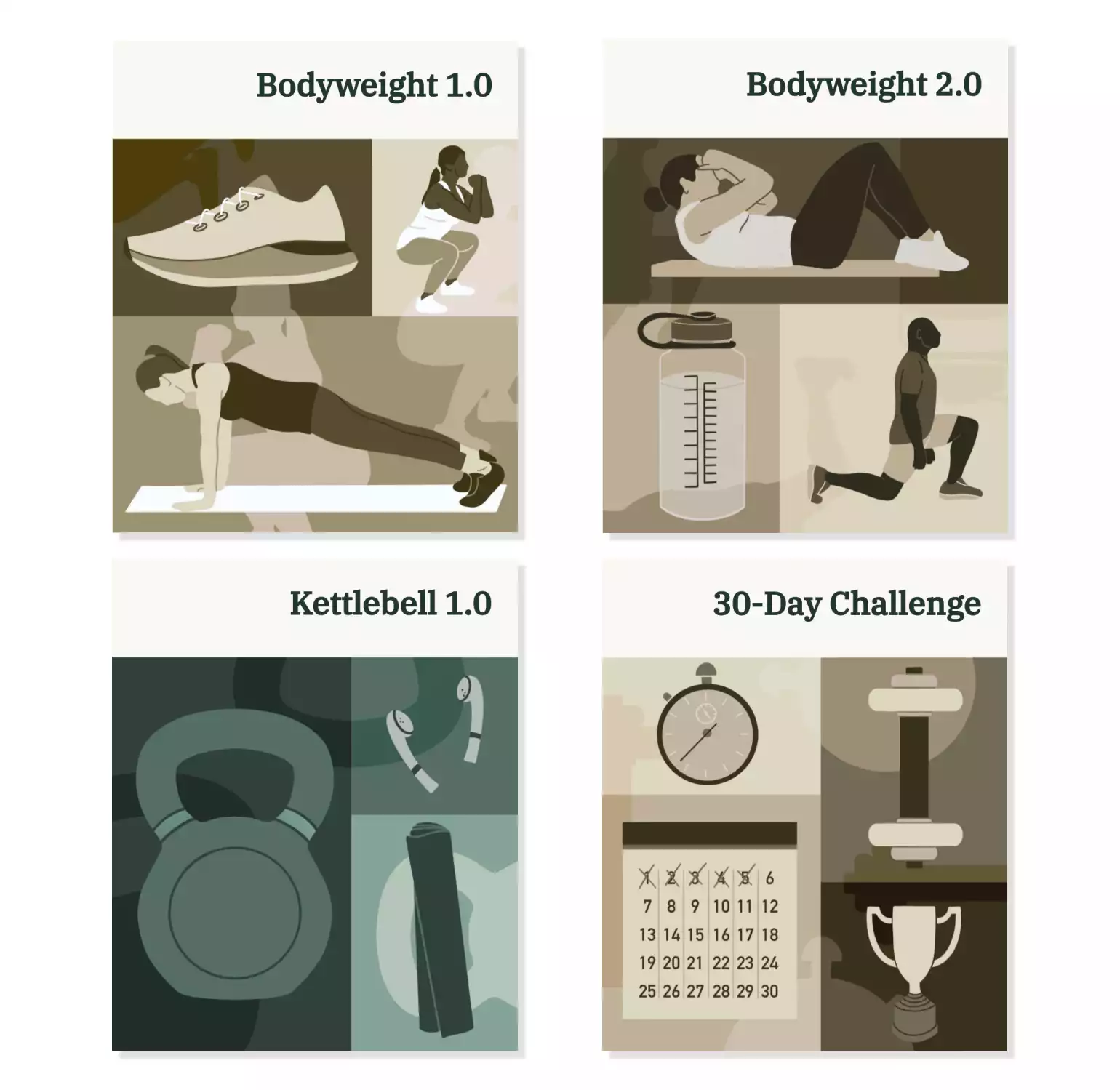 Hybrid Training Bundle - Hybrid Athlete

 Complete Calisthenics - Level 1-3 Bundle | Cali Move
Choose a Program Based on Your Goals
No matter what activity you choose as your primary mode of exercise, it’s important to pick a program that aligns with your goals. If your main goal is to work on your endurance so you don’t get winded as easily when hiking, a program that’s primarily focused on building muscle wouldn’t be as effective as an endurance program.
Some programs don’t really have a stated goal and are more focused on general fitness. That is okay too, but be careful not to choose something that’s too vague. Just like your goals should be specific and measurable, the goals of the program should be, too. Ideally, those goals will be pretty well aligned.
Make Sure the Program Matches Your Level
As a beginner, you’ll want to make sure you’re not biting off more than you can chew. A common mistake people make is buying the flashiest, most popular program on the market, only to find they can’t possibly keep up.
When choosing a program, look at the program’s expectations.
- Do many of the starting exercise variations look impossible to you?
- Does the program entail nonstop work at a relatively high level of intensity?
- Are there clear explanations for exercise technique, or does the program assume you already know what to do for basic exercises?
Be honest with yourself about where you’re starting from and evaluate the program accordingly. Don’t choose a program just because a friend raves about it—you may not be starting from the same place as them.
Building Your Own Training Program
You might decide to build your own exercise program instead of buying or using a ready-made one.
Maybe you have a specific goal that requires a more tailored approach. Or perhaps you’re looking to save money.
Whatever your reason, experimenting with making your own program is a great way to understand exercise methodology.
You can build a workout in many ways, but we’ll give you a framework for understanding which components are most important.
Minimum Effective Dose
The concept of “minimum effective dose” is uncomfortable for many people because it goes against what so many of us have been taught. It’s the direct opposite of “more is better.”
Rather than trying to do as much as you can before collapsing, this concept challenges you to do the least amount possible to see results. Before building an exercise program, try to adopt this mindset that you don’t need to do a lot to see results—especially as a beginner.
Start with less. You can always add more later if you are able to.
General Program Structure
With the “less is more” mindset, you’ll be able to build a healthy and sustainable exercise program. From here, there are four components you’ll need to decide on:
- Mode
- Frequency
- Intensity
- Duration
Mode
This is what type of exercise you’ll be doing. As we discussed in the section on choosing a program, you can really choose anything. As long as you’re moving your body and the type of exercise you’re doing supports your goals, everything else is a personal choice.
We recommend, of course, choosing a mode of exercise you enjoy. If it feels like a chore every time you do it, you’re just not as likely to keep showing up.
Frequency
You’ll need to decide in advance how often you want to work out. We recommend three to five times per week, but this is ultimately going to depend on your lifestyle and preferences.
If you have commitments like a rigorous job or small children at home, it might be more realistic to start with fewer dedicated workouts each week. Or, you might find you’re more consistent in your training when you work it into your schedule more often.
Think about your life realistically, and plan on a frequency that you can stick to. This allows you to get a baseline, which you can always adjust or build upon as you progress.
Intensity
Here’s where you’ll decide how intensely you want to be working. There are objective and subjective ways of determining intensity.
Objective measures include things like setting a target heart rate, speed on a treadmill, or revolutions per minute (RPM) on a bike.
There are various scales for subjective measurements of intensity, but a good one is the ratings of perceived exertion (RPE) scale:
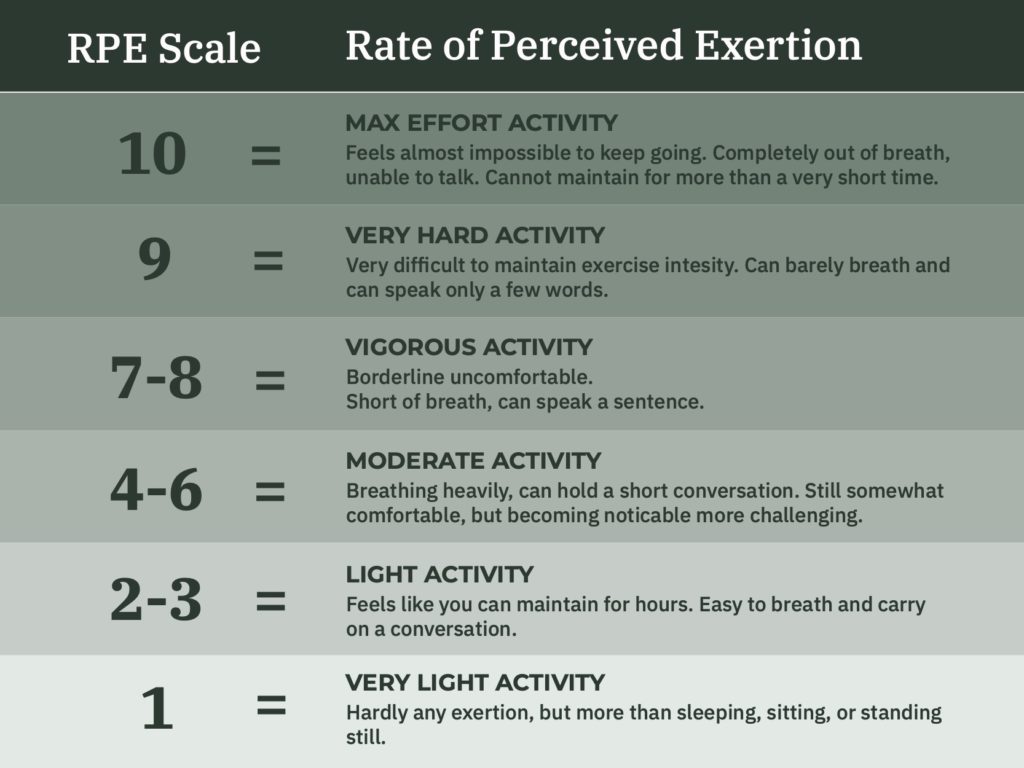
You may want to create your program with a mix of higher- and lower-intensity activity. It’s not a good idea to be at a 9 or 10 on the RPE scale with every single workout (most people really don’t need to go above a 7/8 ever).
Duration
This last component defines how long your sessions will be. It doesn’t have to be the same every time, and it’s important to build some flexibility into your planning since life is rarely predictable and steady.
With that said, try to think about what would be an ideal amount of time to spend on a workout session.
If you’re one of those people who has a lot of internal motivation for exercising and you just love working out, you might relish an hour-long exercise session. For the rest of us, remember it’s about quality over quantity. If you only have 20 minutes you can devote to a workout, then plan for that. Whatever’s realistic.
Creating a Workout for Different Goals
If you choose a less traditional form of exercise (say, dance or swimming), you’ll still want to think about frequency, intensity, and duration, but you may be better off turning to experts on the particular activity for help building a training program.
With more traditional forms of exercise (like bodyweight training or weightlifting), it’s a bit simpler to provide guidance on building workouts.
In general, here’s what we recommend depending on your goal:
- Building strength: use a relatively harder variation of a given exercise for 2–4 sets of 4–6 repetitions per exercise.
- Hypertrophy (building muscle): work with a relatively easier variation that you can do for 2–4 sets of 8–12 repetitions per exercise.
- Building endurance: choose an even easier variation that you can do for 2–4 sets of 12–20 repetitions per exercise.
To gauge the difficulty of an exercise variation, you’ll want to pick a variation where you can do the recommended number of repetitions while keeping a couple of reps in the tank.
So, for example, if you’re working on squats with a goal of building strength, you’ll want to pick a variation of the squat where the absolute maximum you can do is eight reps, but you’ll stop at six. That way, you always stay fresh and can make sure to do each exercise with proper and safe form.
Going From Zero to Advanced Exerciser
How do you progress from absolutely zero knowledge all the way to an advanced exerciser? We’ll show you. Understand, though, that progress is rarely linear.
These benchmarks will give you some general guidelines for navigating through different stages of training. Along the way, though, you might advance more quickly in one area than in another. Or, you might move backward in certain areas at different points in time. That’s okay.
As you’ll see, the key to becoming a lifelong exerciser is to be as consistent as possible in your efforts, and that’s true no matter what stage you’re starting from. We’ll look at four levels:
- Zero
- Beginner
- Intermediate
- Advanced
Starting From Zero
There are many people starting an exercise program who need to take a step back from even beginner-level exercises.
It’s possible you’ve gone years without moving your body in a purposeful way.
There’s no judgment or shame in being honest with yourself about your level of activity. It’s important to know where you’re starting from so that you can take this important step in an enjoyable and sustainable way.
If you’re starting from this place of zero activity, what can you do to get yourself to beginner level? Start with gentle movements, like:
- Walking
- Easy hikes in nature
- Stretching
- Basic bodyweight movements like marching in place or squatting while holding onto a support.
The most important thing at this stage is creating a consistent habit. Don’t worry too much about achieving lofty goals. Your only real goal should be to make movement a regular part of your life—something you do every day for at least a few minutes.
At this early stage in your journey, one of the best things you can do is start a consistent walking program—some of the most successful and sustainable exercise programs are based on walking alone.
Start with a walk around the block every day, then build up to a mile or two per day. This might not sound like a lot, but it can be quite challenging if you’re starting from zero. And making this a part of your daily routine will help you stay consistent with more advanced training as you improve.
Progressing to Beginner Level
Once you’re moving more regularly and are comfortable with basic movements and stretches, you can start working on beginner-level exercises. Here are some ways you can bump up your level of intensity:
- Increase your distance on your walking program, or begin speed walking or jogging.
- Start doing hikes at a moderate level of intensity.
- Make your stretching more dynamic by including yoga fundamentals.
- Try some standard bodyweight exercises, like beginner variations of push-ups or squats. (See our Bodyweight Training Guide for detailed beginner-friendly exercises.)
At this level, it’s important to go back to the goal-setting exercises from earlier. Setting clear goals will help you maintain the consistency you’ve been building. Staying consistent at every level is the necessary ingredient for making this a lifelong endeavor.
Moving up to Intermediate Level
You’ve been at this for a while now. You’re comfortable doing beginner-level progressions of bodyweight exercises like push-ups, squats, and deadlifts. You’re stretching regularly, and you’re on a consistent walking or jogging program. You’re doing activities you love (or have learned to love), so you’ve successfully made exercise a sustainable habit. This is a part of your life now.
At the intermediate level, you can start to:
- Add sprints or intervals into your jogging sessions.
- Do more advanced bodyweight exercise variations.
- Incorporate some weighted strength training with barbells or kettlebells. (See our Strength Training Guide for detailed strength-based exercises.)
As you progress, revisit your goals as necessary—what motivated you at level zero isn’t necessarily going to motivate you now.
Becoming an Advanced Exerciser
This is the goal for many people—to achieve an advanced level of skill and ability. It’s not the right goal for everyone, though. You have to know yourself and understand what’s a realistic, motivating, and healthy goalpost for you.
If you do decide you want to achieve this level of exercise, here’s what that might look like:
- Add hill sprints into your running sessions.
- Do high-intensity interval training (HIIT).
- Use heavier kettlebells or barbells, or practice more technically advanced exercises (such as the Turkish get-up).
- Work on advanced bodyweight exercises like handstands, pull-ups, and gymnastic ring exercises.
The sky’s the limit with what you can work on when you reach a certain level of skill and ability with your exercise. Just pay attention to the following:
- Are you able to maintain your consistency when working at such a high level?
- How does your body feel? If you’re getting injured all the time doing advanced exercises, that’s not going to be sustainable.
- Is this advanced level of work having any impact (positive or negative) on your mental health?
There isn’t a right or wrong answer to any of these questions. It’s important, though, to pay attention to these things, especially as you keep advancing.
Managing Plateaus or Setbacks
There’s something magical about those early days of a new exercise program. You feel excited about the work you’re putting in, and you see consistent results adding up with almost every workout session.
…until you don’t.
After a few weeks or a few months, you hit a wall. It gets harder to muster up excitement for your training sessions, even when you use all the techniques we’ve described throughout this guide. What now?
Don’t Panic and Don’t Give Up
When you hit a plateau like that, it can be tempting to lean into one of two feelings:
- Panic. This is never going to work!
- Resignation. I’m just going to quit while I’m ahead.
We’ve all been there, so we get it. Let’s take a step back to set some realistic expectations.
Reality check #1: Plateaus are inevitable.
No matter your experience level or the amount of effort you’ve put into setting yourself up for success, you’ll likely come across plateaus or setbacks at some point.
Our bodies and minds adapt quickly, especially when starting something new, so when it’s not so new anymore, you’re not as likely to see the same results consistently.
That’s okay. Actually, it’s a good thing. Hitting plateaus means you’re putting in consistent effort.
Reality check #2: Setbacks are unavoidable.
Setbacks can happen for all sorts of reasons—injury, depression, vacation, new job, pandemic, etc. The key is knowing that when a setback happens, it doesn’t have to mean the end of all your progress.
With these realistic expectations in mind, we can go over some strategies for managing setbacks and plateaus when they happen.
How to Manage a Plateau
A plateau is usually seen as a bad thing in the context of an exercise program. It’s when you hit a period of little to no progress and things stay pretty flat for a while.
Here are two main ways to deal with a plateau:
Ride it out
Sometimes, the best way to deal with a plateau is to embrace it and ride it out. It’s unlikely that you’ll be stuck at that same plateau for very long. Often, if you lean into the plateau and just keep showing up, you’ll find yourself on the other side of that plateau within a couple of weeks. If a month or so goes by and you’re still in the same spot, though, it’s probably time to go into troubleshooting mode.
Troubleshoot
Switching things up may mean changing your program entirely or adjusting specific aspects of your program. Go back to the four components of your program we discussed earlier: mode, frequency, intensity, and duration.
Perhaps you need to try a different mode of exercise for a change, or it could be that your body needs a rest in which case you might cut back on intensity or frequency temporarily.
It may take some trial and error to see if changing one or more of these components gets you back on track.
Getting Back on Track Right Away
When you hit a setback and miss a planned session, it can be tempting to go into all-or-nothing mode.
James Clear, who’s a master at habit-building, talks about the importance of “avoiding the second mistake.” Or, as we like to say: Don’t miss twice.
Just because you missed one workout doesn’t mean all of your efforts at exercising should go out the window. Consistent work is the most important thing in building this lifelong habit, and means showing up next time, even if you couldn’t get yourself to the gym this time.
Go back to square one and figure out what changes you need to make to your routine so that you have the best chance of showing up to your next session.
Making This a Lifelong Journey
So, how can you sustain this new exercise journey for the rest of your life? It comes down to three things:
- Staying consistent
- Engaging in self-reflection
- Expecting nonlinear progress
Consistency is Key
Showing up consistently is far more important than all the other details of your exercise program.
It’s more important than what type of exercise you do, how intensely you work out, or even how frequently you exercise. Find something you enjoy and just keep showing up. That’s what creates a sustainable habit.
People overestimate what they can do in an hour and underestimate what they can accomplish in a decade. We think that if we work as hard as possible in an hour-long workout, we should see results right away. When that doesn’t happen, we’re disappointed and may be tempted to give up.
But any accomplishment takes time, and exercise is no different. Even when you’re just getting started, remember that this is a lifelong journey and results accumulate over time.
Your “Why” Will Change
As you get older and have different life experiences, your “why” is going to change. Very few people have the same motivating factors at 20 as they do at 40.
What’s important, then, is continuing to be self-reflective.
Revisit the exercises from the beginning of this guide periodically to make sure you’re clear on what’s most important to you. We recommend going through those exercises at least once a year, reminding yourself of your “why” throughout the year.
Progress Isn’t Linear
You’re going to face ups and downs in your exercise journey, and there will be times when you feel like you’re not making any progress at all—or worse, like you’ve gone backward. You haven’t. Just keep showing up consistently and it will lead to progress.
One year from now, you can look back and know that you’ve made progress because you started this journey—and starting is half the battle.
If you have started and are ready to move forward, check out our guides and training plans to see if there’s a good fit for you.